
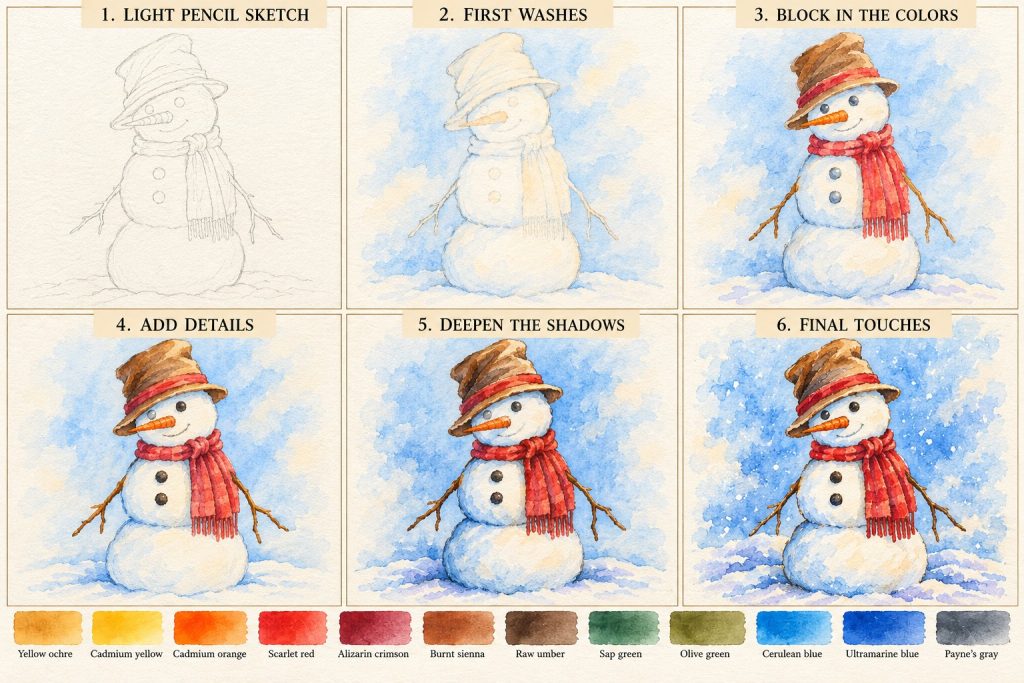
1. Background wash
-
Lightly wet the background around the snowman.
-
Use Cerulean Blue with plenty of water.
-
Add a little Ultramarine in a few areas for variation.
-
Leave some white areas to suggest falling snow.
-
Let dry completely.
2. Snowman – first wash
-
Use a very diluted mixture of Cerulean Blue.
-
Apply lightly along the outside edges of each snowball.
-
Add a touch of warm yellow or Raw Sienna to a few areas.
-
Leave the center portions mostly white.
-
Avoid painting the entire snowman solid white.
3. Hat
-
First wash: Raw Sienna and Burnt Sienna.
-
Add darker Burnt Sienna along the folds and underside of the brim.
-
Use a little Payne’s Gray for the deepest shadows.
-
Paint the hatband with Alizarin Crimson.
4. Face and carrot
-
Keep the face mostly white.
-
Add very light blue shadows beneath the hat brim and around the sides.
-
Paint the carrot with a light orange wash.
-
Once dry, add Burnt Sienna lines and a darker tip.
-
Add the eyes and smile with a small amount of dark pigment.
5. Scarf
-
First wash with diluted Alizarin Crimson.
-
Allow it to dry.
-
Add a second layer of crimson and a little Burnt Sienna for depth.
-
Use darker red in the folds and where the scarf overlaps.
-
Paint the fringe with individual downward brushstrokes.
6. Body details and arms
-
Paint the buttons with Payne’s Gray.
-
Use Burnt Sienna for the twig arms.
-
Add darker brown along one side of each branch.
-
Add subtle blue-gray shadows around the buttons and beneath the scarf.
7. Shadows and depth
This is where the snowman starts looking three-dimensional.
-
Mix Ultramarine with a little Payne’s Gray.
-
Add shadows along the bottom of each snowball.
-
Darken the areas where the snowballs meet.
-
Add a few irregular blue and lavender strokes to the snow beneath him.
8. Final highlights
-
Lift a few areas with a clean, damp brush.
-
Add tiny white highlights if needed.
-
Strengthen the darkest folds in the hat and scarf.
-
Add a few delicate snow marks.
My biggest recommendation
Don’t overwork the snowman. The charm of this particular painting comes from the loose watercolor texture.
Let the paper do some of the work. Leave white spaces, allow colors to blend naturally, and don’t outline everything.
One important tip: Paint the background first, then the snowman, then the hat and scarf, and save the darkest details for last.
That will give you a much softer, more natural watercolor result.